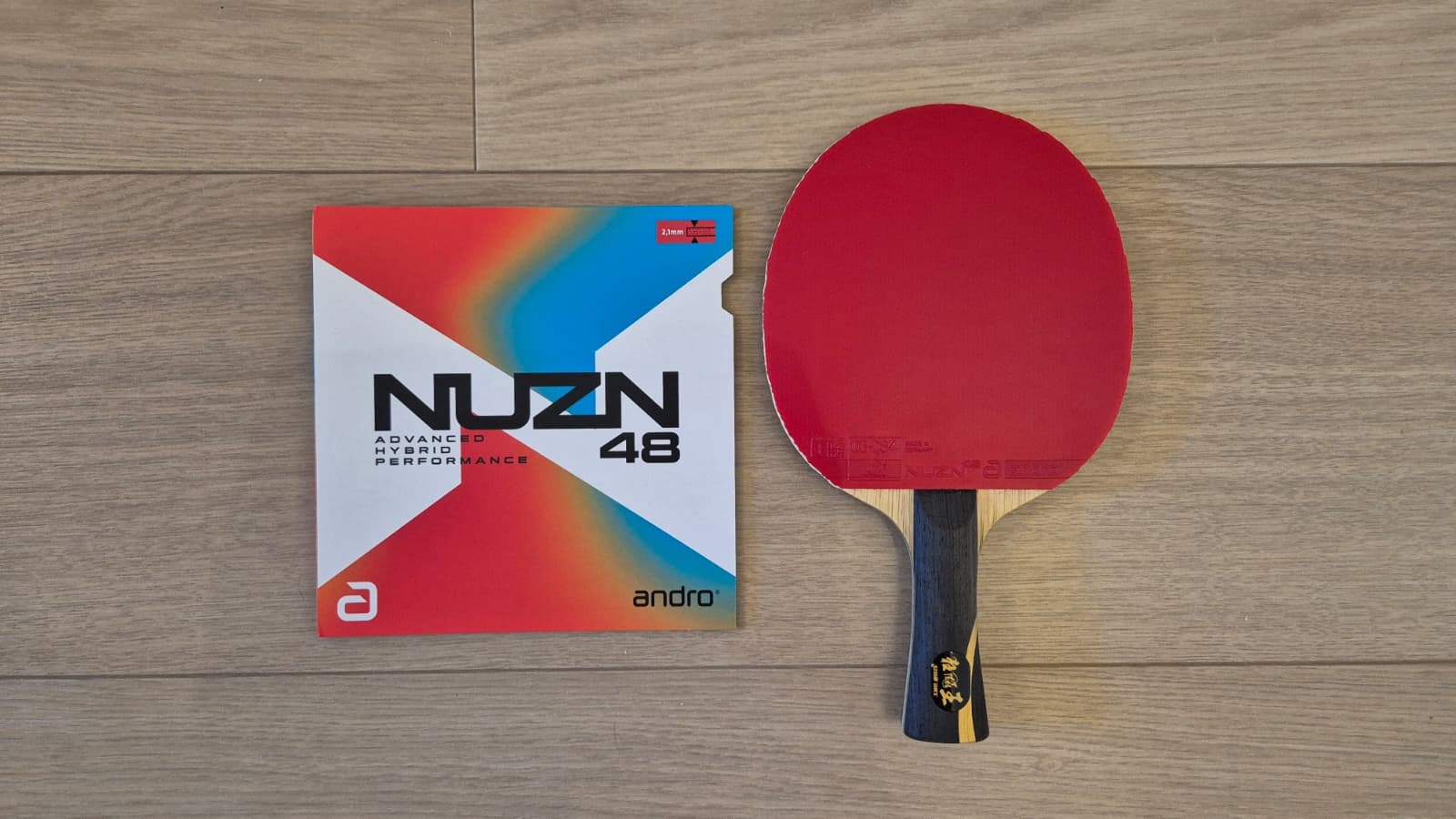
Review: Stepping Up the Power with the Andro NUZN 48
Stefan Heijnis
Following the buzz around the NUZN 45, it’s time to look at its "bigger brother": the Andro NUZN 48. While the 45 focused on stability and high-throw control, the NUZN 48 is designed for the advanced player looking to inject more venom into their game without losing that signature NUZN "vibe."
Power vs. Control: The Ultimate Tradeoff?
The big question with any harder sponge is whether the extra speed kills your control. With the NUZN 48, the answer is a pleasant surprise. While it boasts a significantly higher speed cap and more "kick" than the Andro NUZN 45, it remains remarkably stable in the short game.
Because the sponge is firmer, the catapult effect doesn't trigger immediately on soft touches, allowing for dead-short pushes and precise serves. However, once you engage your body and swing hard, the rubber releases a level of power that the 45 simply can’t match.
Key Performance Shifts
Lower Throw Angle: Unlike the medium-high arc of the 45, the NUZN 48 has a noticeably lower trajectory. This makes it more dangerous for aggressive looping but requires a more closed racket angle when blocking.
Spin & Grip: The topsheet is "tensor-grippy" rather than tacky. It offers massive spin potential for players with good technique, especially on serves and counterloops.
The "Hybrid" Feel: It’s not a traditional sticky Chinese rubber. Think of it as a premium ESN tensor that has been "tamed" in the lower gears for better placement.
Should You Upgrade from the NUZN 45?
The NUZN 48 is a direct evolution. You should consider the switch if:
You’ve "bottomed out" the 45: If you find yourself hitting the speed limit on your winning shots, the 48 provides the extra gears you need.
You prefer a firmer feel: If the 45 felt a bit too "mushy" or bouncy on passive blocks, the 48’s 48-degree sponge offers a more crisp, direct feedback.
You are an advanced attacker: Intermediate players may find the 45 more forgiving, but those with developed strokes will appreciate the 48’s aggressive counterlooping capabilities.
Want the full breakdown on sponge weight, durability, and specific drill results? You can read the deep-dive review and technical analysis here: tabletennisequipmenthelp.com
The JOOLA Trinity Hugo Calderano series has been developed for players who want to combine the spin potential of a grippy rubber with the speed and stability required for modern offensive table tennis.
The series consists of two versions: the JOOLA Hugo Calderano Trinity Dynamic and the significantly harder JOOLA Hugo Calderano Trinity Charged. Although they share the same basic technology, the difference in sponge hardness gives each rubber a distinct character.
The Dynamic is the more versatile and forgiving option, while the Charged is made for technically strong players looking for maximum power and precision.
The Technology Behind the Trinity Series
Both Trinity rubbers combine JOOLA's Energy X Sponge with the grippy Fusion X topsheet. This combination is intended to generate strong rotation while maintaining efficient energy transfer during faster attacking strokes.
The grippy surface helps when producing spin during serves, opening topspins and counter-topspins. At the same time, the sponge provides the acceleration needed to finish points when the player increases the power of the stroke.
The main difference between the two versions is the sponge hardness:
Rubber
Sponge hardness
Main characteristic
Trinity Dynamic
52.5°
Balanced, versatile and more forgiving
Trinity Charged
57.5°
Direct, powerful and technically demanding
JOOLA Hugo Calderano Trinity Dynamic: The More Versatile Choice
The Joola Hugo Calderano Trinity Dynamic uses a 52.5° sponge. This is still a relatively hard rubber, but it is easier to activate than the Charged.
It offers a strong combination of speed, spin and control, making it suitable for players who want to vary their offensive game. The Dynamic can support spin-oriented opening balls, active blocks, counter-topspins and direct attacking strokes without feeling as uncompromising as the harder version.
The slightly softer sponge also creates a little more dwell time. This allows the ball to sink further into the rubber, making it easier to produce rotation and control the direction of the ball. It can be particularly valuable when opening against backspin or when playing under pressure.
The Dynamic is therefore not a soft or slow rubber. It still has considerable speed and requires proper technique. However, it provides a larger margin for error and makes it easier to switch between controlled and powerful strokes. JOOLA positions it as the more adaptable version within the Trinity series.
Who Should Choose the Trinity Dynamic?
The Joola Hugo Calderano Trinity Dynamic is best suited to offensive players who:
Want a balance between speed, spin and control
Use both controlled and powerful topspin strokes
Want a hard premium rubber without choosing an extreme hardness
Play actively on both the forehand and backhand
Prefer a slightly more forgiving response during rallies
For many competitive players, the Dynamic will be the more logical choice. It offers high-end offensive performance without requiring the same level of physical acceleration as the Charged.
JOOLA Trinity Charged: Maximum Power and Precision
The Joola Hugo Calderano Trinity Charged uses an extremely hard 57.5° sponge. It is the most direct and demanding version of the series and is aimed at powerful offensive players with technically clean strokes.
When properly activated, the hard sponge provides exceptional stability and energy transfer. The rubber is especially suitable for aggressive topspins, counter-topspins and finishing shots. During powerful contact, it produces a direct response without the rubber feeling unstable.
The advantage of such a hard sponge is that it remains composed when a player hits the ball with significant acceleration. Instead of bottoming out or becoming unpredictable, the rubber continues to provide support during full-power strokes.
However, the Charged does not provide its performance automatically. Players must generate enough acceleration to engage the sponge. Without the necessary technique and physical input, the rubber can feel hard, unforgiving and difficult to control.
Independent player experiences also suggest that the Charged rewards full strokes and active play. Passive blocks and incomplete strokes may be less effective, while active counter-topspins, powerful forehand attacks and direct finishing balls are where the rubber is most comfortable.
Who Should Choose the Trinity Charged?
The Trinity Charged is designed for players who:
Have advanced or professional-level technique
Generate significant acceleration through their own stroke
Prefer a hard and direct contact feeling
Use powerful forehand topspins and counter-topspins
Want maximum stability during high-impact attacking strokes
For most players, the Charged will be better suited to the forehand. Its hardness and direct response require a confident stroke, good timing and consistent contact.
Dynamic or Charged: Which One Should You Buy?
The decision mainly depends on how much assistance you want from the rubber and how much power you can generate yourself.
Choose the JOOLA Hugo Calderano Trinity Dynamic when you want high speed and spin with more control, versatility and forgiveness. It is the better all-round offensive option and will suit a wider group of competitive players.
Choose the JOOLA Hugo Calderano Trinity Charged when you already have technically strong and powerful strokes and want maximum precision, stability and acceleration. It provides a higher performance ceiling, but it also demands more from the player.
A combination of Charged on the forehand and Dynamic on the backhand can also make sense for advanced players. This creates maximum power on the stronger side while maintaining greater flexibility and control on the backhand.
Read Victor's Complete Review
Equipment specifications only tell part of the story. How a rubber behaves during serves, receives, opening topspins, blocks and counter-topspins is often much more important than the numbers printed on the packaging.
Victor has tested both rubbers and provides a more detailed playing comparison on his website, Table Tennis Equipment Help.
For his complete impressions, comparisons and practical playing experience, read Victor's full JOOLA Trinity Charged and Dynamic review.
The Andro NUZN 45 and NUZN 48 are two high-performance table tennis rubbers designed for different types of players. The NUZN 45 focuses on control, consistency and ease of use, making it ideal for intermediate players. The NUZN 48 offers more speed and power, better suited for advanced players with a more aggressive playing style. Both rubbers deliver strong spin and durability, but differ in how demanding they are to control. Choosing between them depends on whether you prioritise control or attacking performance.
The Andro Synteliac VCI and VCO are high-performance table tennis blades that differ mainly in their carbon placement. The VCI features inner carbon construction, offering more control, dwell time and a softer feel, ideal for spin-focused players. The VCO uses outer carbon, resulting in more speed, directness and power for aggressive play. Both blades use advanced Voltema Carbon technology but deliver distinctly different playing experiences. Choosing between them depends on whether you prioritise control and precision or speed and attacking performance.